M/T Vardefjell
Updated Apr. 23-2012
To Vardefjell on the "Ships starting with V" page.
Crew List

Scanned from "Krigsseileren" mentioned in the text below, original source unknown
Manager: Olsen & Ugelstad, Oslo
Tonnage: 8316 gt, 12 900 tdwt.
Signal Letters: LKLX
Built in Gothenburg in 1940 (launched Dec. 14-1939).
Captain: Nils A. Ambjørnsen.
Related items on this website:
A Guestbook message re the wreck of Vardefjell's bow section.
Another message - From the son of someone who took part in the rescue, Frederik Joensen, now 90 years old (2008).
Guestbook message - From the nephew of Able Seaman/Gunner Harald Skorstad; see crew list below.
Guestbook message - From the sister of one of the casualties, Radio Officer Thomas Henry Dixon.
Her voyages are listed on these original images from the Norwegian National Archives:
Page 1 | Page 2 | Page 3 | Page 4 | Page 5
Please compare the above voyages with Arnold Hague's Voyage Record below.
Voyage Record
From Apr.-1940 to Oct.-1945:
|
(Received from Don Kindell - His source: The late Arnold Hague's database).
Follow the convoy links provided for more information on each.
Errors may exist, and some voyages are missing.
| 1940 |
Apr. 8 |
Gothenburg |
Bermuda |
Apr. 20 |
Independent |
A. Hague says:
Approximate departure date, voyage data unknown |
| |
Apr. 25 |
Bermuda |
Trinidad |
Apr. 30 |
Independent |
– |
| |
May 13 |
Trinidad |
Aruba |
– |
Independent |
– |
| |
May 17 |
Aruba |
Buenos Aires |
June 10 |
Independent |
– |
| |
June 14 |
Buenos Aires |
Curacao |
July 3 |
Independent |
– |
| |
July 6 |
Curacao |
Buenos Aires |
July 29 |
Independent |
– |
| |
Aug. 2 |
Buenos Aires |
Curacao |
Aug. 21 |
Independent |
– |
| |
Aug. 23 |
Curacao |
Buenos Aires |
Sept. 13 |
Independent |
– |
| |
Sept. 17 |
Buenos Aires |
Curacao |
Oct. 5 |
Independent |
– |
| |
Oct. 8 |
Curacao |
Buenos Aires |
Oct. 29 |
Independent |
– |
| |
Nov. 2 |
Buenos Aires |
Capetown |
Nov. 16 |
Independent |
– |
| |
Nov. 18 |
Capetown |
Port Elizabeth |
Nov. 20 |
Independent |
– |
| |
Dec. 14 |
Port Elizabeth |
Durban |
Dec. 17 |
Independent |
– |
| |
Dec. 20 |
Durban |
Bombay |
Jan. 5-1941 |
Independent |
– |
| 1941 |
Jan. 9 |
Bombay |
Abadan |
Jan. 16 |
Independent |
– |
| |
Jan. 21 |
Abadan |
Aden |
Jan. 29 |
Independent |
– |
| |
Jan. 29 |
Aden |
Durban |
Febr. 13 |
Independent |
– |
| |
Febr. 16 |
Durban |
Freetown |
– |
Independent |
Page 1 gives arrival March 4. |
| |
March 7 |
Freetown |
Curacao |
March 19 |
Independent |
– |
| |
March 30 |
Curacao |
Freetown |
Apr. 14 |
Independent |
– |
| |
Apr. 18 |
Freetown |
Curacao |
May 2 |
Independent |
– |
| |
May 5 |
Curacao |
Las Piedras |
May 6 |
Independent |
– |
| |
May 6 |
Las Piedras |
Bermuda |
May 12 |
Independent |
– |
| |
May 14 |
Bermuda |
– |
– |
BHX 127 |
See link to HX 127 |
| |
May 20 |
Bermuda portion joined main convoy |
Liverpool |
June 1 |
HX 127 |
Missing movements, Page 1 |
| |
June 11 |
Liverpool |
– |
– |
OB 334 |
For Curacao.
Detached June 14.
Convoy available at OB 334
(external link) |
| |
June 14 |
Detached from OB 334 |
Curacao |
July 3 |
Independent |
– |
| |
July 7 |
Curacao |
Halifax |
July 17 |
Independent |
– |
| |
July 22 |
Halifax |
Liverpool |
Aug. 7 |
HX 140 |
See also narrative below.
Missing movements, Page 1. |
| |
Aug. 13 |
Liverpool |
– |
– |
OS 3 |
Via Belfast Lough
(Page 1).
Detached in 48 30N 21 50W, Aug. 18.
Convoy available at OS 3
(external link) |
| |
Aug. 18 |
Detached from OS 3 |
Curacao |
Aug. 31 |
Independent |
– |
| |
Sept. 1 |
Curacao |
Las Piedras |
Sept. 2 |
Independent |
– |
| |
Sept. 5 |
Las Piedras |
Curacao |
Sept. 5 |
Independent |
– |
| |
Sept. 8 |
Curacao |
Trinidad |
Sept. 11 |
Independent |
– |
| |
Sept. 15 |
Trinidad |
Puerto la Cruz |
Sept. 16 |
Independent |
– |
| |
Sept. 17 |
Puerto la Cruz |
Caracas* |
Sept. 18 |
Independent |
*Curacao |
| |
Sept. 19* |
Caracas* |
Trinidad |
Sept. 23 |
Independent |
A. Hague says:
Notional sailing date
*Page 2 gives departure Curacao Sept. 21. |
| |
Sept. 27 |
Trinidad |
Puerto la Cruz |
– |
Independent |
– |
| |
Sept. 29 |
Puerto la Cruz |
Curacao |
Sept. 30 |
Independent |
– |
| |
Oct. 3 |
Curacao |
Trinidad |
Oct. 5 |
Independent |
– |
| |
Oct. 9 |
Trinidad |
Curacao |
Oct. 12 |
Independent |
– |
| |
Oct. 13 |
Curacao |
Trinidad |
Oct. 15 |
Independent |
– |
| |
Oct. 21 |
Trinidad |
Las Piedras |
Oct. 23 |
Independent |
– |
| |
Oct. 24 |
Las Piedras |
Aruba |
Oct. 25 |
Independent |
– |
| |
Oct. 29 |
Aruba |
Trinidad |
Oct. 31 |
Independent |
– |
| |
Nov. 5 |
Trinidad |
Puerto la Cruz |
Nov. 6 |
Independent |
– |
| |
Nov. 6 |
Puerto la Cruz |
Curacao |
Nov. 8 |
Independent |
– |
| |
Nov. 11 |
Curacao |
Trinidad |
– |
Independent |
Page 2 gives arrival Nov. 14. |
| |
Nov. 19 |
Trinidad |
Puerto la Cruz |
– |
Independent |
Page 2 gives arrival Nov. 20. |
| |
Nov. 21 |
Puerto la Cruz |
Curacao |
Nov. 22 |
Independent |
– |
| |
Nov. 24 |
Curacao |
Las Piedras |
Nov. 25 |
Independent |
– |
| |
Nov. 26 |
Las Piedras |
Curacao |
Nov. 27 |
Independent |
– |
| |
Nov. 30 |
Curacao |
Las Piedras |
Dec. 1 |
Independent |
– |
| |
Dec. 1 |
Las Piedras |
Halifax |
Dec. 12 |
Independent |
– |
| |
Dec. 15 |
Halifax |
Liverpool |
Dec. 29 |
HX 165 |
– |
| 1942 |
Jan. 12 |
Liverpool |
– |
– |
ON 56 |
Missing movements, Page 2
For Curacao.
Dispersed 59 00N 17 00W, Jan. 16.
Convoy will be added.
See ships in ON convoys |
| |
Jan. 16 |
Dispersed from ON 56 |
Puerto la Cruz |
– |
Independent |
– |
| |
Febr. 4 |
Puerto la Cruz |
Aruba |
Febr. 6 |
Independent |
– |
| |
Febr. 11 |
Aruba |
Freetown |
Febr. 28 |
Independent |
– |
| |
March 2 |
Freetown |
Puerto la Cruz |
– |
Independent |
– |
| |
March 17 |
Puerto la Cruz |
Curacao |
March 18 |
Independent |
– |
| |
March 26 |
Curacao |
Cristobal |
March 29 |
Independent |
– |
| |
March 30 |
Balboa |
Wellington |
May 2 |
Independent |
– |
| |
May 6 |
Wellington |
Auckland |
May 9 |
Independent |
– |
| |
May 15 |
Auckland |
Balboa |
June 13 |
Independent |
– |
| |
June 27 |
Balboa |
La Libertad |
July 1 |
Independent |
– |
| |
July 2 |
La Libertad |
Balboa |
July 5 |
Independent |
– |
| |
July 11 |
Cristobal |
Gitmo |
July 15 |
PG 1 |
Convoy available at PG 1
(external link) |
| |
July 17 |
Guantanamo |
Key West |
July 21 |
TAW 4G |
Convoy available at TAW convoys
(external link) |
| |
July 22 |
Key West |
Hampton Roads |
July 26 |
KN 122 |
Convoy available at KN convoys
(external link) |
| |
July 28 |
Hampton Roads |
New York City |
July 30 |
Independent |
Notional sailing date |
| |
Aug. 1 |
New York City |
Cape Cod Bay |
– |
Independent |
– |
| |
Aug. 6 |
Cape Cod Bay |
Halifax |
Aug. 7 |
BX 32 |
Convoy available at BX convoys
(external link) |
| |
Aug. 16 |
Halifax |
Liverpool |
Aug. 28 |
HX 203 |
Missing movements, Page 3 |
| |
Sept. 4 |
Clyde* |
Clyde |
Sept. 5 |
ON 127 |
*From Liverpool.
Put back Clyde, engine defects |
| |
Sept. 11 |
Clyde |
Clyde |
Sept. 12 |
ON 129 |
Returned.
Convoy will be added.
See ships in ON convoys |
| |
Sept. 19 |
Clyde |
New York City |
Oct. 4 |
ON 131 |
Convoy will be added.
See link above |
| |
Nov. 19 |
New York City |
Clyde |
Dec. 4 |
HX 216 |
– |
| |
Dec. 11 |
Clyde |
– |
– |
KMS 5 |
Broke in two, after end afloat
(see also narrative below) |
| |
Dec. 13 |
Broke in two from KMS 5 |
– |
– |
Independent |
Taken in tow, Jan. 2-1943. |
| 1943 |
Jan. 2 |
Taken in tow |
Kirkwall |
– |
In tow |
Page 3 gives arrival Jan. 5, beached |
| |
Febr. 22 |
Kirkwall |
Methil |
Febr. 25 |
In tow |
– |
| |
March 4 |
Methil |
Tyne |
March 5 |
In tow |
– |
| 1944 |
July 18 |
Tyne |
Tyne |
July 18 |
Independent |
Port re-building trials |
| |
July 19 |
Tyne |
Methil |
July 20 |
FN 1422 |
Convoy available at FN convoys
(external link) |
| |
July 22 |
Methil |
Loch Ewe |
July 24 |
EN 411 |
Convoy available at EN convoys
(external link) |
| |
July 25 |
Loch Ewe |
New York City |
Aug. 9 |
ON 246 |
Convoy will be added.
See ships in ON convoys |
| |
Aug. 13 |
New York City |
Philadelphia |
Aug. 13 |
Independent |
– |
| |
Aug. 15 |
Philadelphia |
New York City |
Aug. 16 |
Independent |
– |
| |
Aug. 17 |
New York City |
Liverpool |
Sept. 1 |
HX 304 |
Missing movements, Page 3 |
| |
Sept. 7 |
Liverpool |
Philadelphia |
Sept. 23 |
ON 252 |
Convoy will be added.
See link above |
| |
Sept. 26 |
Philadelphia |
Hampton Roads |
Sept. 27 |
Independent |
– |
| |
Oct. 2 |
Hampton Roads |
Marseilles |
Oct. 28 |
UGS 56 |
A. Hague says:
Arrival date approximate
(Page 4 says via Oran Oct. 20).
Convoy available at UGS convoys
(external link) |
| |
Oct. 30 |
Marseilles |
Port de Bouc |
Oct. 30 |
Independent |
– |
| |
Nov. 16 |
Port de Bouc |
Algiers |
Nov. 18 |
Independent |
Via Marseilles
(Page 4) |
|
Nov. 25 |
Algiers |
Port de Bouc* |
Nov. 28 |
OM 22 |
Convoy available at OM 22
(external link)
*Page 4 gives arrival Marseilles Nov. 28 |
| |
Dec. 2 |
Marseilles |
Toulon |
Dec. 2 |
Independent |
– |
| |
Dec. 5 |
Toulon |
Naples |
Dec. 7 |
Independent |
– |
| |
Dec. 11 |
Naples |
Marseilles |
Dec. 14 |
Independent |
– |
| |
Dec. 19 |
Marseilles |
Oran |
– |
Independent |
Page 4 gives arrival Dec. 22. |
| |
Dec. 22 |
Oran |
Algiers |
Dec. 23 |
Independent |
– |
| |
Dec. 26 |
Algiers |
Bone |
Dec. 27 |
Independent |
– |
| |
Dec. 29 |
Bone |
Augusta |
Dec. 31 |
Independent |
– |
| 1945 |
Jan. 7 |
Augusta |
Brindisi |
Jan. 8 |
Independent |
– |
| |
Jan. 9 |
Brindisi |
Bari |
Jan. 9 |
Independent |
– |
| |
Jan. 12 |
Bari |
Ancona |
Jan. 13 |
Escorted |
– |
| |
Jan. 17 |
Ancona |
Algiers |
Jan. 23 |
Independent |
– |
| |
Jan. 29 |
Algiers |
Naples |
Febr. 1 |
Independent |
– |
| |
Febr. 2 |
Naples |
Leghorn |
Febr. 4 |
VN 101 |
Convoy available at VN convoys
(external link) |
| |
Febr. 8 |
Leghorn |
Naples |
Febr. 10 |
NV 101 |
Convoy available at NV convoys
(external link) |
| |
Febr. 14 |
Naples |
Leghorn |
Febr. 16 |
VN 105 |
Convoy available at VN convoys
(external link) |
| |
Febr. 20 |
Leghorn |
Naples |
Febr. 21 |
NV 106 |
Convoy available at NV convoys
(external link) |
| |
Febr. 21 |
Naples |
Algiers |
Febr. 23 |
Independent |
– |
| |
March 2 |
Algiers |
Marseilles |
March 4 |
Independent |
– |
| |
March 11 |
Marseilles |
Algiers |
March 14 |
Independent |
– |
| |
March 17 |
Algiers |
Marseilles |
– |
Independent |
– |
| |
March 24 |
Marseilles |
Oran |
March 27 |
Independent |
– |
| |
March 28 |
Oran |
Baltimore |
Apr. 13 |
GUS 80 |
Convoy available at GUS convoys
(external link)
Via Hampton Roads
(Page 4) |
| |
Apr. 22 |
Baltimore |
Philadelphia |
Apr. 24 |
Independent |
– |
| |
Apr. 26 |
Philadelphia |
New York City |
– |
Independent |
– |
| |
Apr. 29 |
New York City |
Liverpool |
May 15 |
HX 353 |
Escort Oiler.
Convoy will be added.
See ships in HX convoys |
| |
May 22 |
Liverpool |
New York City |
June 5 |
ON 304 |
Convoy will be added.
See ships in ON convoys |
| |
June 12 |
New York City |
Avonmouth |
June 24 |
Independent |
– |
| |
June 29 |
Avonmouth |
New York City |
July 11 |
Independent |
– |
| |
July 14 |
New York City |
London |
July 27 |
Independent |
See also Page 5 |
| |
July 30 |
London |
Houston |
– |
Independent |
Page 5 gives arrival Aug. 8. |
| |
Aug. 24 |
Houston |
Antwerp |
Sept. 13 |
Independent |
Via Downs
(Page 5) |
| |
Sept. 16 |
Antwerp |
Lake Charles |
Oct. 7 |
Independent |
– |
| |
Oct. 10 |
Lake Charles |
Tyne |
Oct. 31 |
Independent |
Via Kirkwall
Subsequent voyages, Page 5 above |
|
Misc. Convoy Voyages – 1941-1942:
|
For information on voyages made prior to and in between those mentioned here, please see the documents received from the National Archives of Norway and A. Hague's Voyage Record above. Follow the convoy links provided for more details on them; several Norwegian ships took part.
Her 1940 voyages are shown on Page 1 of the archive documents. It'll be noticed that she had quite a long stay in Port Elizabeth that winter. Her 1941 voyages also start on this document.
With a cargo of fuel oil for Manchester, she's listed in the Bermuda portion of Convoy HX 127 in May-1941. The following month, she shows up in Convoy OB 334, which left Liverpool on June 11 and arrived Halifax on the 25th (see external link provided within the Voyage Record; Bur, Chr. Th. Boe, Morgenen, Nova, Petter, President de Vogue and Stigstad are also named) - Vardefjell, however, was bound for Curacao, where she arrived on July 3 (Page 1). A. Hague says she had been detached from the convoy on June 14. From Curacao, she proceeded to Halifax a few days later, with arrival July 17. She had been scheduled for Convoy HX 139 on July 16, but instead joined the next convoy on July 22, HX 140, together with the Norwegian Madrono (station 112), Boreas (16), Velox (56), Velma (96), Alaska (106), Stiklestad (95), Thorshov (83), Evita (114), Olaf Bergh (124), Skiensfjord (97), Ferncastle (113), Thorshavet (43), Bonneville (82) and Helgøy (77). Bur and Chr. Th. Boe are also mentioned; Beth and Petter were also initially in this convoy but left due to engine problems. Vardefjell had a cargo of crude oil for Liverpool, where she arrived on Aug. 7, having sailed in station 84.
Later that month, she's listed in station 54 of Convoy OS 3, voyaging from Liverpool to Curacao, with departure Liverpool on Aug. 13. This was a Freetown bound convoy, which arrived there on Sept. 1, but according to A. Hague, she was detached on Aug. 18 and arrived Curacao on Aug. 31. Again, see the link in the table above for more convoy info; Havsten and Garonne are also listed (see also Sandar). Vardefjell left Curacao again for Las Piedras the next day, with arrival Sept. 2. Her voyages in this period are shown on Page 2. Christmas that year was celebrated while in Convoy HX 165, departing Halifax for the U.K. on Dec. 15.
Vardefjell returned across the Atlantic with Convoy ON 56*, which left Liverpool on Jan. 12-1942 and dispersed on the 16th. Her destination is again given as Curacao; she arrived Aruba, via Puerto la Cruz, on Febr. 6. Her subsequent voyages are listed on the archive doucment referred to above, as well as on Page 3 - convoy information for some of them can be found in the Voyage Record.
Skipping now to Aug. 16-1942, when we find her among the ships in the Halifax-U.K. Convoy HX 203, crude oil for Manchester. She's also mentioned in the westbound Convoy ON 127, departing Liverpool for New York on Sept. 4 (several Norwegian ships were torpedoed, follow the link for details), but she put back to Clyde with engine problems, and from there, she later joined ON 129* (originated in Liverpool on Sept. 11), but again returned to port. She eventually got away with ON 131*, which sailed from Liverpool on Sept. 18 and arrived New York, Vardefjell's destination, on Oct. 4. Commodore had been in Abraham Lincoln. Vardefjell subsequently remained in New York for several weeks (Page 3), until she on Nov. 19 joined Convoy HX 216. She had a cargo of fuel oil and sailed in station 42, bound for Clyde for orders, with arrival there Dec. 4 (it looks like this cargo was meant for North Africa - see next paragraph).
* The ON convoys will be added to individual pages in my Convoys section in due course, along with further details on each. In the meantime, the ships sailing in them (and escorts) are named in the section listing ships in all ON convoys. Several Norwegian ships took part.
More information on the other Norwegian ships mentioned here can be found via the alphabet index at the end of this page, or go to the Master Ship Index.
|
A Backwards Voyage with Half a Ship - 1942:
|
Vardefjell was to take part in the Torch operations, which had commenced in Nov.-1942 ( Athos has a list of other Norwegian ships taking part). On Dec. 11-1942, a week after having arrived with Convoy HX 216, she departed Clyde in Convoy KMS 5 for North Africa, cargo of oil. Shortly before midnight on Dec. 13 she broke in two in a storm with heavy seas, with the result that the forepart drifted off with all the officers and the others who were on watch there, 10 in all, while 31 were left on the afterpart. When the foreship came drifting along the port side, those on the afterpart attempted to launch lifeboats, but in the bad weather there was nothing they could do to help their shipmates. 2 lifeboats were launched, which were both destroyed in the heavy seas, and those who had already manned one of them fell into the water. The majority managed to climb back on the ship with the help of the nets, except 1st Engineer Ugelstad and Stoker Opheim, who disappeared. Any thought of reaching their shipmates now had to be abandonded. (The last time they saw the forepart was around 07:00 in the morning of Dec. 14). It was then decided that it might be possible to take the rest of the ship to port. According to the 3rd issue of "Krigsseileren" for 1972, the boatswain, Einar Halvorsen was chosen as the "leader". In spite of the continuous hurricane winds blowing, and in spite of his lack of navigational skills, he was able to get them all through the 11 days ordeal, with the help of 2nd Engineer Anders Skotheim and Carpenter Lauritz Uggedal , and of course, by the joint efforts of all on board. He had painted "Vardefjell: Send help S.O.S. Can't steer" in big, bold letters on the boatdeck. A ship had been seen during the first night, and another the next morning, but to their dismay, though the desperate signals from the men on Vardefjell were acknowledged, the ships sailed on.
On Dec. 18, a British aircraft flew in over the wreckage, but soon took off. 2 days later another 2 planes appeared and circled for 2 hours without making contact. Before they departed they dropped 2 red "smoke bombs", but no one knew what this meant. On the 22nd a Sunderland aircraft came in low, signalling in morse code to them, but again nobody understood what it meant, and the plane took off a couple of hours later, then returned that evening, dropping red lights. Naturally, the exhausted men hoped that this meant help was on its way.
When land was spotted on the night leading up to Christmas Eve, Halvorsen guessed it to be either Ireland or Scotland, and so it was that some fishermen at Vaag (Faroe Islands) on Christmas Eve encountered half a tanker sailing backwards. When the rescuers came closer and hailed them in Danish the 29 survivors of Vardefjell learned they had, in fact, reached the Faroe Islands. The fishermen took the seamen to port, and that same afternoon S/S Smiril transported the 2nd engineer back to the wreck in the hopes of being able to take it to shore, but this failed. The weather was too bad the following day to repeat the attempt, but on Dec. 26 the 2nd and 3rd engineers were again taken out to search for the ship, this time without finding it at all. However, subsequent attempts must have succeeded because Vardefjell was taken in tow to Kirkwall, and later to Sunderland; it was even possible to save 3000 tons of her oil. According to Page 3 of the archive documents, she arrived Kirkwall in tow on Jan. 5-1943, remaining there until Febr. 22, when she proceeded to Methil, then Tyne.
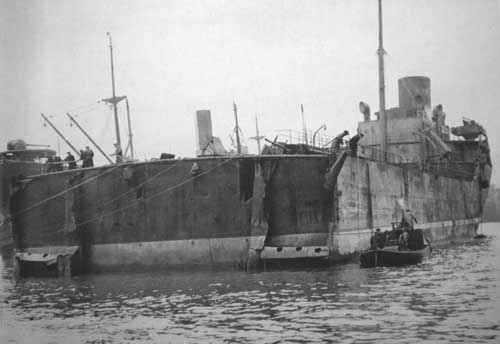
Received from Arve Wiborg, Norway.
My Ship Forum has a posting (by Roy Martin) stating the following:
A short version of an article in the TOWROPE, the journal of the Deep Sea Rescue Tugs Association, by Reg Frampton Signalman on Marauder.
Christmas Eve 1943 ss Vardefjell
MARAUDER was first stationed at Campbeltown, followed by Milford Haven, Falmouth, Plymouth, Scapa Flow, Campbeltown (again) and then Stornaway. On Christmas Eve 1943 (actually 1942?) MARAUDER sailed from the latter port to go to the assistance of the Norwegian tanker VARDEFJELL, had broken in half while in convoy in a North Atlantic storm. When MARAUDER found the casualty a boat was sent away with Lt McCorke (a noted Cornish yachtsman) and a crew of six. After a ‘hellish trip’ the boats crew boarded the tanker and connected the tow; easy to write, but very difficult to do. As soon as MARAUDER took the strain the towline parted and, with the weather deteriorating even further, the crew were marooned on a dead ship. They could see their tug with her stern rising out of the water and her racing propellers visible. Eventually the C.O. Lt Cdr Jennings RNR signalled that he would have to take the tug to the Faroes for shelter. It should be remembered that an important part of his crew was on the casualty, so the tug was shorthanded. In the final signal the tug informed those on the VARDEFJELL that they were drifting towards a minefield! Because of oil leaking from the cargo they were unable to light fires and it was snowing and bitterly cold. After several days, during which the weather moderated a little, they were found by the ex Hull trawler HMS KINGSTON AGATE. They were taken off by the trawlers boat, they found that the motion on the trawler was even worse than it had been on their tug. Even getting the remains of a hot meal was a rarity. Reg Frampton, the MARAUDER’s signalman says that the trawler’s crew ‘were a wild bunch, they had not had any leave for a long time’: this coming from a member of a crew who had, in the early days, ‘a reputation for causing trouble wherever they were’!
In January 1943 the MARAUDER was again sent to salvage the hulk, which had been spotted by an aircraft, close to the occupied coast of Norway. This time the salvage was successful, with the casualty being redelivered to the Faroes. The tow back to the UK is not covered. By 1944 the VARDEFJELL was back in service with a new bow. With the engines the stern half of a ship is of far more value than the bow.
At the maritime hearings, which were held in Thorshavn on Dec. 29-1942, it was concluded that the ship had been under too much strain in trying to keep up with the convoy speed in the heavy weather, and Nortraship later sent out a note to all captains stating that it was their duty and within their rights to inform the Commodore if they felt that the speed would jeapordize their ships in bad weather. The boatswain, the 2nd engineer, the 4th engineer, Able Seaman Skorstad, Able Seaman Finnskog and Mechanic Andersen attended the inquiry.
Crew List:
* Here's a Guestbook message from the nephew of Harald Skorstad (who died in Florida in 1997). He had previously served on Hallanger and Daghild, later Petter and Dalfonn - see also this external page.
** Sigurd Svendsen had previousy served on Ivaran.
*** This Swedish seaman can also be found among the crew of the Norwegian Thorstrand, and I believe he may also have served on Dagfred.
|
Survivors
|
|
Carpenter
Lauritz Uggedal
|
Boatswain
Einar Halvorsen
|
Able Seaman
Jens Flatebø
|
Able Seaman
Martin Fromeide
|
Able Seaman
John Vallin Pettersen
|
Able Seaman
Trygve Larsen
|
|
Able Seaman
Rolf Lein
|
Able Seaman
Trygve Geitrheim
|
Able Seaman
Ivar Finnskog
|
Able Seaman/Gunner
Trygve E. Olsen
|
Able Seaman/Gunner
Harald Skorstad*
|
Able Seaman/Gunner
Bjørn Søilen
|
|
2nd Engineer
Anders Skotheim
|
3rd Engineer
Henry Gjervik
|
4th Engineer
Johan Lien
|
Electrician
Sigurd Svendsen**
|
Repairman
Karl I. Karlsen
|
Mechanic
Odvard Andersen
|
|
Mechanic
Harald Olsen
|
Mechanic
Josef Iversen
|
Mechanic
Paul Bråten
|
Pumpman
Bertil Sommelius***
(Swedish)
|
Stoker
Nils Jakobsen
|
Oiler
Michael Melia
(British)
|
|
Oiler
Hans Rødberg
|
Engine Boy
David Cotten
(British)
|
Cook
Alf Andersen
|
2nd Cook
Kornelius Kristiansen
|
Mess Boy
Alexander Murray
(British)
|
|
|
Casualties:
|
|
†
Captain
Nils A. Ambjørnsen
|
†
1st Mate
Kristian R. Riege
|
†
2nd Mate
Gerhard Lervåg
|
†
3rd Mate
Carl M. Larsen
|
†
Radio Operator
Charles A. Shand*
(Canadian)
|
†
Radio Operator
Thomas Henry Dixon
(British)
|
|
†
1st Engineer
Rolf Uglestad
|
†
Stoker
John S. H. Opheim
|
†
Jr. Ord. Seaman/Gunner
Henry Hansen
|
†
Steward
Andreas Fjukstad
|
†
Galley Boy
Walter Williams
(British)
|
†
Saloon Boy
Joseph Beagan
(British)
|
* The Canadian Radio Operator is commemorated on Panel 20 at the Halifax Memorial; I found this information on him at the Commonwealth War Graves Comm. website (external link). I cannot find a commemoration for Radio Operator Dixon (but here's a Guestbook message from his sister), nor can I find the British galley boy and saloon boy.
It'll be noticed, when going to the Stavern Memorial below, that in addition to those listed in my crew list, there's also an Able Seaman Anker Halvorsen and a Steward Olaf Olsen commemorated. "Våre falne", a series of 4 books naming Norwegians who died during the war, has a Steward Olaf Olsen with the same birthdate, saying he had served as steward on Siljestad, but joined another ship (not named) and was taken prisoner in the Philippines. Died during transport off the coast of China on Oct. 24-1944 - see also my POW's page. Checking further, I found him in the roster for Arusan Maru (external links - the Internet holds several more), which was torpedoed on this date. This ship had left Manila on Oct. 10-1944 with 1800 on board, torpedoed by an American submarine on Oct. 24, with only 9 survivors. Anker Halvorsen is also listed in Våre falne" - in fact, he was among those who died at Saranac Lake (March 6-1944) and is pictured on my page about the seamen who died there - please follow the link for more info. It's possible he had served on Vardefjell at some point.
Related external link:
Stavern Memorial commemorations - Norwegians only are commemorated at this Memorial for Seamen in Stavern, Norway. Some of the names are spelt a little differently here, and different titles have been given to a few of them. The following are named:
Captain Nils-Ambjørn Ambjørnsen, Seaman Andreas Fjukstad, Gunner Henry Johan Hansen, Mechanic John Stolt Heggen Opheim, Seaman Carl Martin Larsen, 2nd Mate Gerhard Johan Lervaag, Mate Christian Rougtvedt Riege, and Chief Engineer Rolf Bunkholt Ugelstad, all listed above. As mentioned, the site has added Able Seaman Anker Halvorsen, and Steward Olaf Olsen - again, see my note above.
|
Further Convoy Voyages – 1944-1945:
|
A new foreship was built, and Vardefjell continued to sail through the rest of the war, and for many years thereafter. She was ready to return to service in July-1944 (it'll be noticed, when going back to Page 3, that she had spent a long time at Tyne, where she had arrived on March 5-1943, going out for trials on July 18-1944). She joined the westbound North Atlantic Convoy ON 246*, which originated in Liverpool on July 25 and arrived New York on Aug. 9 (Commodore in Brimanger) - Vardefjell joined from Loch Ewe. On Aug. 17, she headed back to the U.K. in Convoy HX 304 (Vice Commodore in Emma Bakke). Vardefjell was bound for Stanlow where she arrived Sept. 1/2, subsequently returning across the Atlantic with Convoy ON 252*, leaving Liverpool on Sept. 7 (Commodore in Geisha). Acanthus, Rose and Tunsberg Castle are named among the escorts for this convoy, as is Buttercup, which came under the Norwegian flag following the loss of Tunsberg Castle - see ON convoy escorts. Vardefjell arrived Philadelphia Sept. 23. She later shows up in Convoy UGS 56, departing Hampton Roads for Port Said on Oct. 2, but Vardefjell stopped at Oran on Oct. 20, continuing to Marseilles that same day - see the external link in the Voyage Record (as will be seen, several ships had other destinations than Port Said, and some joined the convoy en route). Her subsequent voyages are shown on Page 4 , with convoy info for some of them in the table above.
She did not return to the U.S. again until March-1945, when she's listed in Convoy GUS 80 (link in Voyage Record). No voyage information is given for her but from Page 4, we learn that she sailed from Oran on March 28 and arrived Hampton Roads on Apr. 13, Baltimore that same day. She subsequently headed to the U.K. again, joining Convoy HX 353* from New York on Apr. 29, arriving Liverpool on May 15; in other words, VE Day was celebrated at sea. A. Hague says she served as Escort Oiler for this convoy. This time, Samuel Bakke served as Commodore Vessel. A week later, Vardefjell joined the westbound Convoy ON 304*, and arrived New York June 5. Page 5 shows the rest of her voyages, to Apr. 11-1946, when she departed Curacao for Oslo, Norway.
Accordingto this external page, Vardefjell was sold in Nov.-1951 to Rio Guaba Cia. Nav., Panama and renamed Vigilant. Renamed Andros Vigor in 1956, Andros Cloud in 1957. Sold for breaking up at Brodospas, Split in Febr.-1959.
Back to Vardefjell on the "Ships starting with V" page.
Olsen & Ugelstad had previously had another ship by this name, built in Porsgrunn in 1931. This external page has more details.
The text on this page was compiled with the help of: "Nortraships flåte", J. R. Hegland, an article in the Norwegian magazine "Krigsseileren", Issue No. 3 for 1972, "Sjøforklaringer fra 2. verdenskrig", Volume II (Norwegian Maritime Museum), and misc. - (ref. My sources).
|
 Merchant Fleet Main Page | Warsailors.com Home