Site Map | Search Warsailors.com | Merchant Fleet Main Page | Warsailors.com Home Merchant Fleet Main Page | Warsailors.com Home |
|
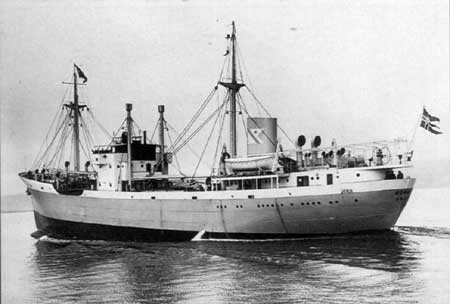
M/S Bomma To Bomma on the "Ships starting with B" page. Owner: A/S Ganger Rolf Built at Akers mek. Verksted, Oslo in 1938. Captain: Henry Lois Johannessen. Her voyages are listed on these original images from the Norwegian National Archives: Please compare the above voyages with Arnold Hague's Voyage Record below.
(Received from Don Kindell - His source: The late Arnold Hague's database). Follow the convoy links provided for more information on each. Errors may exist, and the record is incomplete.
Bomma was southbound with general cargo and was off Romsdal, Norway when 2 German aircraf flew in low on Apr. 9-1940 (the day of the German invasion of Norway). The captain dropped anchor and the crew took refuge in the woods. She later anchored up in Langfjord and was camouflaged. In May-1940 she joined the allied troops when they pulled out from the area, took on board 12 refugees and arrived safely at Lerwick on May 4 - see also Page 1 of the archive documents (it'll be noticed that she later spent quite a long time in Leith). That summer, Bomma transported 40 million kroner worth of Norway's gold from the U.K. to Baltimore. Several other Norwegian ships also made voyages to the U.S. with Norway's gold on board. She was briefly in Convoy OA 162, which left Southend on June 5-1940 and dispersed 2 days later. The Norwegian Harpefjell and Tiradentes are also listed in this convoy. Bomma's destination is given as Hampton Roads - ref. external link provided in the Voyage Record. Note that according to Page 1, she arrived Falmouth on June 11, proceeding to Baltimore on the 15th, with arrival there on June 28 (remaining for almost a month). This must have been the voyage on which she transported the Norwegian gold - see narrative below.
"In order to save the gold of the Bank of Norway (Norges Bank), 3000 gold-bullions, a weight of 49 tons – a value of NOK (Norwegian Kroner) 240 millions- was loaded onto 25 lorries in Oslo in the early hours of the 9th. April 1940. The gold was packed in 818 big boxes, 685 small boxes and 39 barrels, all marked “NB”. Officer-in-Chief was Fredrik Haslund, and with him he had 30 soldiers as guards, but only one, the famous poet Nordahl Grieg, knew what was inside the boxes. The bank-staff and the lorry-drivers were all armed with revolvers. In Lillehammer the gold was transferred to a special train, and sent north through the Gudbrandsdal Valley. In Otta the train was “camouflaged” with false litra numbers to cover up its real destination, and from Dombås the train was directed down to Åndalsnes on the Rauma line, where it arrived on the 20th April. British troops were landed in Åndalsnes, and the small town was under heavy bombardment from German planes. 1/3 of the gold cargo was loaded onto the British cruiser Galathea, the rest was supposed to be loaded on two other ships for security reasons. Meanwhile, to secure the train and its cargo, the train was backed up the valley to Romsdalshorn station, until 25th April, while shipping transport was prepared. As the Germans were reported to advance fast up the Gudbrandsdal Valley, the rest of the gold was loaded on trucks again and taken further to Molde. The Germans were eager to capture the gold, and all railway-personnel in Gudbrandsdal Valley was questioned, but the camouflage worked and the Germans never found out which route the gold-train had taken. From Molde some of the gold was put onboard the British cruiser Glasgow (if I'm not mistaken the King and the Crown Prince were also on board at the time and landed in Tromsø) and in the end of April shipped to England. The rest was loaded onto fishing vessels and other small vessels, and brought safely to Tromsø, a long journey in dangerous waters, as German planes were everywhere. Among others, the fishing vessels Alfhild and Staulvåg together with the small passenger Snorre, took part in this transport. From Tromsø the gold was shipped to England in the late days of May on the British cruiser Enterprise which arrived in Plymouth the 29th May, and from there taken to London on a special train with heavy escort of soldiers and police. In the night of the 15th June the Norwegian freighter Bomma left England with the first cargo of gold for USA (again, see Page 1). The gold was loaded in barrels on deck, each barrel tied firmly to several other empty barrels, so the whole unit would stay afloat if the ship would be sunk. Another 13 transports followed. In addition to Bomma, the following Norwegian ships took part in this transport: Bra-Kar, Ida Bakke, Norma and San Andres. The gold was safely deposited in the Federal Reserve Bank of New York and Bank of Canada. The gold and its long journey to safety became some kind of national symbol, and its real value could no longer be measured in money. The British Government was in the autumn 1940 in a desperate situation concerning the currency situation, and pressure was put upon the Norwegian Government to hand over the gold, but the Norwegian gold was already brought further across the Atlantic to Canada and USA during June and July 1940, on British and Norwegian merchant ships. Of the five Norwegian ships who brought the gold across the Atlantic, only Bra-Kar was lost during the war; it was set ablaze and damaged beyond repair during an air raid in Liverpool 1941". Bomma's subsequent voyages are shown on the various documents received from the National Archives of Norway - follow the links provided further up on this page. Convoy information for a few of them can be found in the Voyage Record above. As can be seen when going to Page 10, she made several voyages home to Norway in the course of 1945 and again in the spring of 1946.
Sold in 1966 to A/S Ansea (Skibs A/S Karlander), Oslo and renamed Slidre, according to this external page. The site (Lillesand Sjømannsforening) adds that she in 1970 was owned by Pacific Trading & Nav. Ltd. (Madrigal Shipping Co.), Panama, same name. 1971, Pacific Trading & Nav. Ltd. (Madrigal Shipping Co.), Manila, no name change. 1975, Madrigal Shipping Co. Inc., Manila, Phillipines, same name. On May 21-1976, she drifted ashore during a typhoon while anchored near Apra, Guam in 13 26N 144 38E. Wreck sold for breaking up "as lies". Related external links: Stavern Memorial commemoration - Jens Lauritz Jensen is commemroated, said to have died on board on June 8-1942, exact cause is not given. According to Page 4, Bomma was at Puntarenas on that date. Back to Bomma on the "Ships starting with B" page. Other ships named Bomma: The company had previously had another ship by this name, built 1920, purchased in 1923, sold in 1938 - see D/S Molla. A 3rd Bomma was built in Trondheim in 1970, sold in 1980 to Hafship, Reykjavik and renamed Sela. The text on this page was compiled with the help of: "Nortraships flåte", J. R. Hegland, Fred. Olsen & Co. fleet list, and misc. - ref My sources.
|
|||||||||||||||||||||||||||||||||||||||||||||||||||||||||||||||||||||||||||||||||||||||||||||||||||||||||||||||||||||||||||||||||||||||||||||||||||||||||||||||||||||||||||